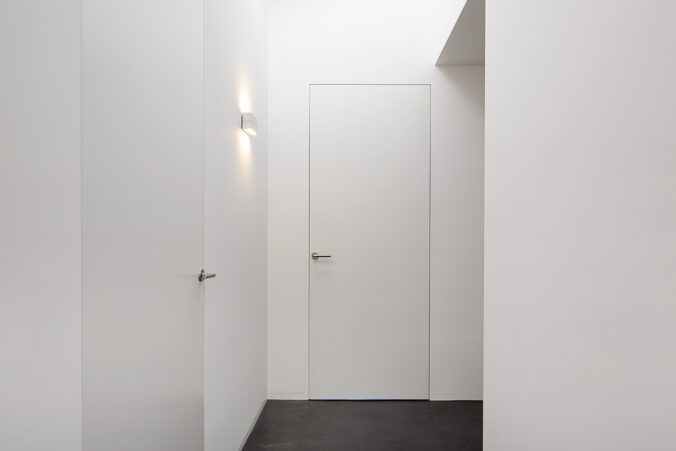
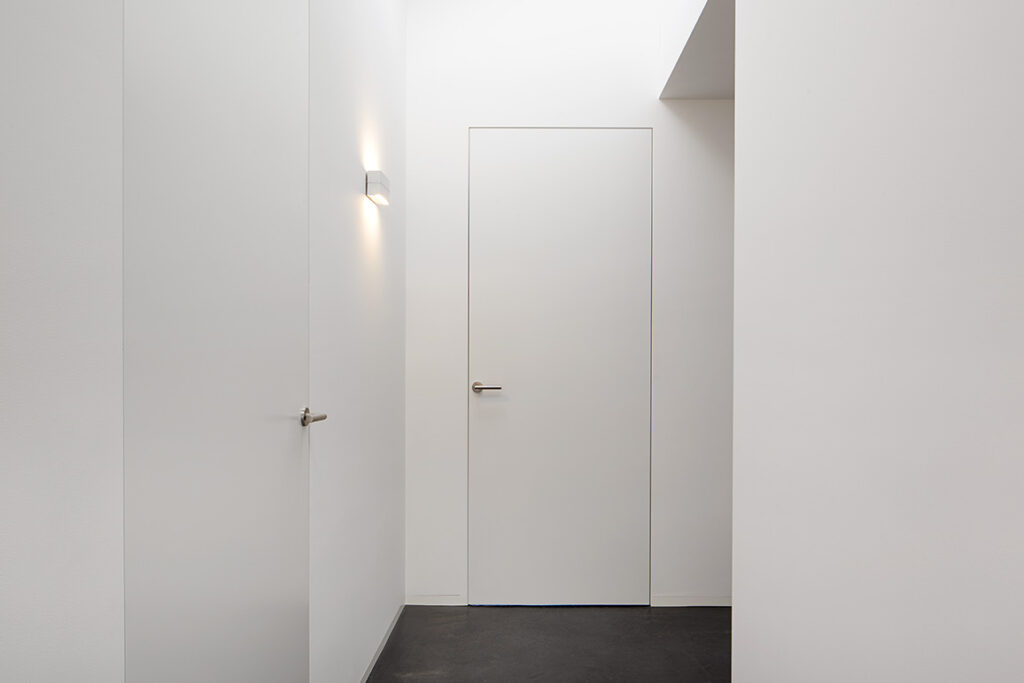
Look closely at the most striking modern interiors and you will notice something missing: the door frame. No casing, no trim, no shadow line of a jamb. The wall simply opens, and the door sits flush with the plane around it.
These are frameless doors, and they are quietly becoming one of the defining details of contemporary architecture. Where traditional doors announce themselves with moldings and borders, these doors just disappear. In a modern interior, that disappearance is the whole point.
Why Modern Architects Are Discovering Frameless Doors
Architects have long been obsessed with clean planes. A wall is a pure surface, and every trim, casing and reveal interrupts it. Frameless doors solve that problem by letting the door become part of the wall rather than an object attached to it.
The approach grows out of modernist thinking. Pioneers of the movement favored continuous surfaces, hidden joints and spaces that flow without visual clutter. Today’s architects are rediscovering that discipline, and the frameless door is its most practical expression inside the home.
There is also a question of proportion. A flush, full-height modern door can run floor to ceiling, which stretches a room vertically and removes the awkward band of wall above a standard frame. Hallways feel taller, rooms feel calmer, and sight lines stay uninterrupted from one space to the next.
Finally, there is honesty of detail. Because frameless interior doors have no casing to hide behind, the wall, the door and the junction between them must be resolved with precision. Architects treat that precision as a mark of quality, and clients increasingly recognize it.
Interior Designers Who Believe Less Is More
Interior designers are embracing the same idea from a different angle. For them, frameless doors are a tool for editing a room down to what matters: texture, light, proportion and furniture.
A door with heavy trim competes with art, millwork and statement pieces. A frameless door steps back. Paint it the same color as the wall and it nearly vanishes, which lets a sculptural chair or a graphic rug take center stage.
Designers also value the calm that comes from fewer lines. Every trim edge is a line the eye must process. Remove them and a hallway reads as one quiet surface, a small change that makes a home feel larger and more deliberate.
There is a storytelling benefit too. Frameless doors let a designer hide the practical, such as a utility room, a pantry or a powder room, behind a seamless wall. Guests discover these spaces by surprise, and the interior feels more like a composed whole than a collection of rooms.
Where does this Minimalist Look Work in Modern Interiors
Modern doors without frames suit a range of design strategies. Four stand out.
- The seamless corridor. Paint doors and walls in one tone, or clad both in the same veneer, so a long hallway reads as a single continuous surface.
- The full-height statement. Run doors from floor to ceiling in open-plan homes, where tall openings add drama and make ceilings feel higher.
- The hidden room. Conceal closets, pantries and service spaces behind flush panels, keeping the architecture uncluttered.
- The warm minimalist. Pair frameless doors with natural oak, plaster walls and soft lighting. Minimal does not have to mean cold.
Success depends on planning. These hidden doors belong in the design from the start, with the wall build-up, ceiling height, flooring and lighting coordinated early. A shadow gap at the junction, rather than trim, gives the opening a crisp, intentional edge.
The Quiet Future of the Door
Frameless doors in mostly urban centers show how much a single detail can change a space. By removing the trim, architects and designers reveal the wall, the light and the proportions of the room itself.
As modern interiors lean further toward calm, continuity and craft, concealed doors will keep moving from the edge of design culture to its center. The best modern doors are the ones you barely notice, and that is exactly why they matter.
Modern Bedrooms have very unique and interesting ideas when it comes to futuristic sleep pods. Have a look at my earlier post.